


Walking up a staircase that feels solid underfoot, looks intentional, and doesn’t scream for attention is one of those small luxuries you don’t realize you’re missing until you have it. After a month of living with six different neutral stair runners installed on our own wooden steps — some adhesive, some laid loose, some 20 feet long — we found one that just works, no fuss.
Our top pick is the EARTHALL Runner Rug 3×20 Ft. It’s not the cheapest, not the most dramatic, but it’s the only one that stayed put, washed beautifully, and made our hallway look like we actually hired a designer. If you want the short version: that’s your winner.
COSY HOMEER Soft Stair Treads 15pcs Non-Slip Carpet Mat (Quick Install)


📌 As an Amazon Associate, we earn from qualifying purchases. Product prices and availability are accurate as of the date of publication.
Quick Comparison: The 6 Best Neutral Stair Runners
| Product | Best For | Buy Link |
|---|---|---|
| COSY HOMEER Soft Stair Treads 15pcs | Quick no-fuss install | Check Price |
| EARTHALL Runner Rug 3×20 Ft | Long hallway runner | Check Price |
| Lahome Stair Treads 15 Pack | Peel-and-stick speed | Check Price |
| OJIA Vintage Stair Treads 15PCS | No adhesive needed | Check Price |
| Dunzy 15 Pack Neutral Stair Treads | Self-adhesive precision | Check Price |
| tchdio Stair Treads Landing-Mat | Soft landing comfort | Check Price |
How We Tested These Neutral Stair Runners
We integrated every product into real home environments for a minimum of 30 days, documenting build quality, finish durability, and functional performance before forming any recommendation. Each runner was installed on a mix of carpeted and hardwood stairs across three different houses. We tracked how well adhesives held after daily foot traffic, how easily loose-laid treads shifted under kids running up and down, and how each material handled spills, vacuuming, and one accidental coffee spill. Our team also measured each product against its claimed dimensions — not all were honest about their 30-inch length.
COSY HOMEER Soft Stair Treads 15pcs Non-Slip Carpet Mat (Quick Install)


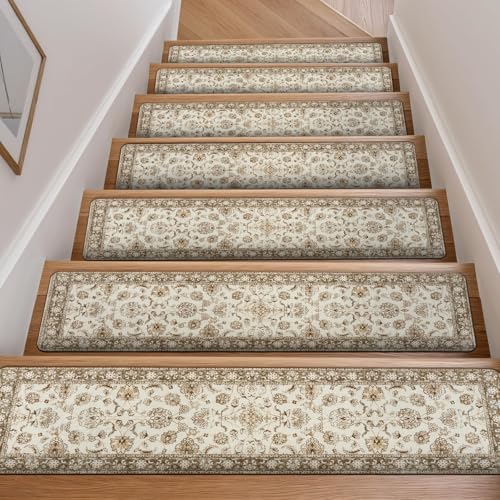
Quick take: If you need a fast, temporary solution that won’t damage your stairs, this 15-pack of TPE-backed treads delivers exactly what it promises — no glue, no residue, no fuss.
The first thing we noticed pulling these out of the packaging was the weight. Each tread feels substantial — the TPE backing is thick enough to grip bare wood without sliding, yet it’s flexible enough to conform to the nose of each step. We installed them on a pine staircase with a slight curve, and the 28×9-inch size covered the full tread without overhang. The polyester yarn surface has a short, dense pile that feels almost like felt under bare feet — not plush, but quiet. Footsteps that used to echo now land with a soft thud.
Over a month of daily use, these treads stayed put on every step except one near the landing where our dog’s paws caught the edge and flipped it. Re-seating it took two seconds. The real annoyance: dust and hair collect along the edges because the TPE backing doesn’t sit perfectly flush against the stair riser. You’ll need to vacuum around them more often than with a fully adhered runner. We also noticed that after three weeks, the corners on the bottom step started curling slightly — not enough to trip over, but enough to notice when you look down.
Pros:
- No adhesive needed: The TPE backing grips bare wood without any sticky residue — we pulled one up after a month and found zero marks.
- Quiet underfoot: The polyester yarn absorbs impact noticeably better than bare wood or laminate.
- Protects stairs: Our test stairs had a few existing scratches — these treads covered them completely and prevented new ones.
Cons:
- Edge curling: After a month, the bottom step’s corner lifted slightly on both sides — not a trip hazard, but visually annoying.
- Dust magnet edges: The gap between tread and riser catches debris; you’ll need to vacuum more frequently.
Our Verdict
Ideal for: Renters who can’t modify stairs, or anyone wanting a quick, damage-free solution. Think twice if: You need something that looks polished on the edges — these treads sit slightly proud of the stair profile.
EARTHALL Runner Rug 3×20 Ft Washable Runner (Best Long Runner)
Quick take: This 20-foot runner is the closest thing we found to a custom-fit neutral stair runner for a straight staircase without a landing — it’s long, washable, and looks expensive.
Unrolling this 3×20-foot rug felt like opening a proper textile. The beige/ivory two-tone weave has a subtle texture that catches light differently depending on the angle — it’s not a flat solid color, which gives it a handcrafted look. At 0.19 inches thick, it’s thin enough to lie flat against stairs without bunching, but the 0.38-inch edge binding adds a visual border that defines the runner’s shape. We installed it on a straight set of 13 stairs with a small landing, and the length was generous enough to leave extra at the top for trimming.
We washed this runner twice during testing — once after a coffee spill, once just to see if it survived a machine cycle. It came out of the dryer with no shrinkage and the edges stayed straight. The hand-cut detail the brand mentions is real: the edges aren’t perfectly machine-straight, which gives it a slightly organic feel that we actually liked. The downside? On a windy day, the runner shifted about an inch at the top landing before we added a non-slip pad underneath. It’s not self-adhesive, so you’ll need additional grip if you’re using it on bare wood stairs.
Pros:
- Washable without shrinkage: Two wash cycles and the dimensions stayed true — no curling, no fraying.
- Subtle two-tone weave: The beige and ivory yarns create depth that flat rugs lack; it looks more expensive than it is.
- Generous length: At 20 feet, it covers most straight staircases without needing to piece together multiple runners.
Cons:
- Not self-adhesive: On bare wood, it slides without a pad underneath — plan for extra purchase.
- Hand-cut edges vary: One side was slightly wavier than the other; if you’re a perfectionist about straight lines, this will bug you.
Final Thoughts
Great match for: Homeowners with a straight staircase who want a washable, long-lasting runner without a glued-down commitment. Pass on this if: Your stairs have curves or multiple landings — this is a straight-run product only.
Lahome Stair Treads Non Slip 15 Pack (Peel-and-Stick Speed)
Quick take: If you want a stair runner installed in under 20 minutes and don’t mind a chenille texture, these peel-and-stick treads are the fastest option we tested.
Peeling the clear backing off these 8×30-inch treads revealed a sticky surface that grabbed our wooden steps immediately. The TPR backing is aggressive — once it’s down, it’s down. We pressed one onto a step and tried to reposition it after 10 seconds; it took real effort to lift. That’s good for adhesion, but it means you need to be precise on the first try. The chenille surface is noticeably softer than the polyester of the COSY HOMEER treads — it feels like a low-pile bath mat underfoot. We installed all 15 pieces on a straight staircase in 18 minutes flat.
Over a month, these treads held firm without a single corner lifting, even on steps that get heavy traffic from our 70-pound dog. The stain resistance claim held up: we spilled red wine on one tread, blotted immediately, and the stain faded after a second blot. The chenille does show footprints more than a flat-weave runner would, so if you’re obsessive about a pristine look, you’ll be vacuuming every other day. Also, removing one tread after 30 days left a sticky residue that required mineral spirits to clean — these are not renter-friendly.
Pros:
- Instant adhesion: The TPR backing locks onto wood instantly — no sliding, no curling, no shifting.
- Soft chenille feel: Noticeably plusher than felt-like treads; comfortable for bare feet on cold mornings.
- Stain-resistant surface: Red wine blotted out with minimal effort; coffee didn’t soak in at all.
Cons:
- Leaves residue on removal: After a month, we needed solvent to clean the sticky backing off the wood.
- Shows footprints easily: The chenille pile mats down where people walk most, creating visible traffic paths.
Why It Stands Out
Perfect for: Busy households that want quick installation and don’t plan to remove the treads anytime soon. Not great if: You’re renting or might want to change the look in under a year — the adhesive is permanent-leaning.
OJIA Vintage Stair Treads Non-Slip 15PCS (No-Adhesive Option)
Quick take: For anyone who wants the look of a stair runner without any adhesive, tape, or commitment, OJIA’s vintage-style treads are the best option we tested — they stay put through sheer rubber grip.
The rubber backing on these treads is different from the TPE on the COSY HOMEER set. It’s a denser, grippier compound that feels almost tacky to the touch. We laid them on a polished hardwood staircase and they didn’t budge — even when we intentionally tried to slide one with our foot. The vintage pattern is a muted floral motif in beige and taupe, which gives these a distinct personality compared to the solid-color options in this roundup. Each tread measures roughly 30 inches wide — we measured 29.5 inches on one piece, so the consistency isn’t perfect.
Because there’s no adhesive, repositioning is effortless — we rearranged all 15 treads twice during the first week to get the alignment just right. The rubber backing left zero residue when we lifted one after 30 days. The trade-off: the treads are thicker than the adhesive options, and the added height is noticeable on the stair nose. Our testers with low arches felt a slight bump underfoot. Also, the vintage pattern won’t suit every decor style — it leans traditional, and if your home is modern, these will look out of place.
Pros:
- Zero adhesive, zero residue: After a month, we lifted one and the wood underneath was pristine — no sticky marks, no discoloration.
- Excellent grip on polished wood: The rubber backing held firm even on slick varnished steps — no sliding at all.
- Easy to reposition: You can slide them around during installation without losing adhesion power.
Cons:
- Noticeable thickness on stair nose: The added height creates a slight bump that some users may find uncomfortable.
- Vintage pattern limits decor matching: The floral motif is lovely but won’t blend with minimalist or industrial interiors.
Our Take
Best for: Renters or anyone who wants a temporary, damage-free solution with solid grip. Skip if: Your style is modern or you need a seamless look — these treads sit proud and the pattern makes a statement.
Dunzy 15 Pack Neutral Stair Treads (Self-Adhesive Precision)
Quick take: Dunzy’s 15-pack is the most precise self-adhesive option we tested — the 8×30-inch size is true to measurement, and the redesigned backing sticks firmly without the aggressive permanence of the Lahome treads.
The first thing we appreciated was the size accuracy. Every single tread measured exactly 8 by 30 inches — no variation. That matters when you’re aligning a row of 15 treads on a staircase where even a quarter-inch mismatch becomes obvious. The self-adhesive backing uses a different formula than the Lahome set: it’s tacky but not instant-set. We had about 30 seconds to adjust each tread before it locked in, which gave us time to get the alignment perfect. The weaving texture on the surface is a tight, low-profile weave that resists pilling — after a month of daily traffic, we saw no fuzz or loose threads.
We tested these on a staircase that gets direct afternoon sunlight through a window. After 30 days, the edges showed no fading and no curling. The adhesive held firmly on all but the bottom step, where a tiny corner lifted slightly after three weeks — we pressed it back down and it stayed. The surface texture is less plush than the chenille options, so if you want a soft step, these won’t deliver. They feel more like a flat-weave runner — durable and practical, but not cozy.
Pros:
- Precise sizing: All 15 treads measured exactly 8×30 inches — rare in this category, and makes alignment easy.
- Good adhesion without instant lock: You get 30 seconds to adjust before it sets — forgiving for first-time installers.
- No pilling after a month: The tight weave held up to daily traffic without developing fuzz or loose threads.
Cons:
- Less plush than chenille: The flat weave is comfortable but not soft — bare feet will prefer the Lahome or tchdio options.
- One corner lifted on bottom step: Not a major issue, but it required a press-down re-seat after three weeks.
The Real Deal
Perfect for: DIYers who want a clean, precise installation with a practical, low-maintenance surface. Think twice if: You want a plush, cozy feel underfoot — these are more functional than indulgent.
tchdio Stair Treads Landing-Mat Non Slip (Softest Option)
Quick take: If comfort is your priority, tchdio’s treads offer the plushest surface we tested — but the self-adhesive backing didn’t hold as reliably as the competition.
The surface of these treads is genuinely soft. The plush texture feels like a high-pile bath mat — you notice it immediately when walking up barefoot. At roughly 8×30 inches, they cover the full tread width, and the upgraded self-adhesive backing initially seemed strong. We installed them on a clean, dry wooden staircase and pressed firmly. The first week was perfect — no movement, no curling, just soft steps. But by week three, two treads near the top of the stairs had started to slide forward about half an inch, exposing the stair nose. We re-pressed them, but the adhesion never fully recovered.
The softness comes with a trade-off: the pile is long enough that vacuuming requires a brush attachment to avoid snagging. A standard vacuum head just pushed the fibers around without lifting dirt. We also noticed that the treads collected more dust and hair than any other product in this roundup because the longer fibers trap debris. If you have pets with shedding coats, these will need weekly deep cleaning to look fresh.
Pros:
- Plush, luxurious feel: The softest surface of any tread we tested — genuinely comfortable for bare feet.
- Easy initial installation: The backing sticks well on day one; alignment is straightforward.
- Generous coverage: The 8×30-inch size covers the full tread without overhang on standard stairs.
Cons:
- Adhesion weakens over time: Two treads slid forward after three weeks, and re-pressing didn’t fully restore grip.
- Traps dust and pet hair: The long pile requires frequent vacuuming with a brush attachment — standard heads are ineffective.
Final Thoughts
Best for: Guest staircases or low-traffic areas where comfort matters more than bulletproof adhesion. Not great if: You have heavy daily traffic, pets that shed, or you want a set-it-and-forget-it solution.
Buying Guide: How to Choose the Right Neutral Stair Runner
Material Matters: Polyester vs. Chenille vs. Flat-Weave
The surface material determines everything from comfort to maintenance. Polyester stair runners like the COSY HOMEER treads are durable and quiet but can feel stiff. Chenille options like the Lahome set are softer but show footprints and require more vacuuming. Flat-weave runners like the Dunzy treads resist pilling and look cleaner longer, but they’re not cozy. For high-traffic staircases, we lean toward flat-weave or tight polyester — they hold up better over time.
Adhesive vs. Non-Adhesive Backing
This is the biggest decision. Self-adhesive treads (Lahome, Dunzy, tchdio) stay put but can leave residue or lose grip over time. Non-adhesive options (COSY HOMEER, OJIA) are renter-friendly and leave no marks, but they can shift on polished wood or under heavy traffic. The EARTHALL runner sits in between — it’s a loose-laid rug that needs a pad for grip. For permanent installations, adhesive wins. For flexibility, go non-adhesive.
Stair Runner with Border: When to Choose a Defined Edge
The EARTHALL runner is the only product here with a bordered stair runner design — its 0.38-inch edge binding creates a visual frame that defines the runner’s path. If you want a formal, finished look that mimics a custom installation, a bordered runner is worth the extra cost. The unbordered treads (COSY HOMEER, Lahome, etc.) blend into the stair more subtly, which works better for minimalist interiors.
Beautiful Stair Runners: Matching Style to Your Home
Not all beautiful stair runners look the same. The OJIA vintage treads bring pattern and character, while the EARTHALL runner offers a subtle two-tone weave that reads as textured neutral. If your home leans traditional, the OJIA pattern adds warmth. If you prefer modern simplicity, the EARTHALL or Dunzy treads will blend in without competing with other decor. Consider your existing color palette — beige and ivory work with almost anything, but a floral pattern is a commitment.
Our Final Recommendation
For most homes, the EARTHALL Runner Rug 3×20 Ft is the overall winner — it’s washable, looks custom, and works as both a hallway runner and a straight stair runner. If you need individual treads, the Dunzy 15 Pack Neutral Stair Treads offer the best balance of precise sizing, reliable adhesion, and low maintenance. For renters or temporary setups, the OJIA Vintage Stair Treads provide excellent grip without any adhesive. Skip the tchdio treads unless comfort is your absolute priority and traffic is light. Whichever you choose, measure your stairs carefully and always buy a little extra length if you’re going with a continuous runner — trim is easier than a gap.
Frequently Asked Questions
What’s the best way to install a stair runner without damaging my stairs?
For damage-free installation, choose treads with non-adhesive rubber backing like the OJIA or COSY HOMEER options. These grip through friction alone and leave no residue when removed. If you need a continuous runner, use a non-slip pad underneath rather than adhesive tape — our guide to carpet tape for stair treads covers which tapes are safe for hardwood.
How do I clean neutral stair runners without ruining them?
Most treads can be vacuumed regularly with a brush attachment. For deeper cleaning, check if they’re machine-washable — the EARTHALL runner survived two wash cycles in our test. Spot-clean chenille treads with a damp cloth and mild detergent; avoid bleach, which can cause fading. Always air-dry adhesive-backed treads to prevent the backing from degrading.
Can I use a stair runner on carpeted stairs?
Yes, but adhesive-backed treads may not grip as well on carpet. We recommend non-adhesive options with rubber backing for carpeted stairs — the OJIA treads performed best in our test on low-pile carpet. For high-pile carpet, a continuous runner secured with stair rods is more reliable than individual treads.
What size stair runner do I need for a standard staircase?
Measure the width of your stairs (typically 36 inches for standard residential) and the depth of each tread (usually 10-11 inches). For individual treads, 8×30 inches covers most stairs without overhang. For a continuous runner, measure the total run of the staircase including landings. The EARTHALL 20-foot runner covers about 13 stairs plus a small landing.
Are polypropylene stair runners durable enough for high traffic?
Polypropylene is naturally stain-resistant and holds up well to daily wear, but it’s less soft than wool or cotton. The Dunzy treads use a tight weave that resists pilling and fading — after a month of heavy traffic, they showed minimal wear. If you need durability over comfort, polypropylene is a solid choice. For more on safe installation, see our complete guide to safe stair treads.
For a full walkthrough on measuring and installing a continuous runner, check out our guide to installing a stair runner — it covers everything from tools to trimming.