

Best peel and stick wallpaper for laundry room: NuWallpaper Cream Vinyl Grassweave wins for its moisture-resistant vinyl construction and natural texture that hides imperfections. Laundry rooms deserve better than bare walls, but traditional wallpaper installation in a humid, high-traffic space feels like overkill. Removable wallpaper gives you the design upgrade without the commitment or mess.


| Product | Best For | Buy Link |
|---|---|---|
| NuWallpaper Cream Vinyl Grassweave | Moisture resistance | Check Price |
| NuWallpaper Navy Secret Garden | Bold patterns | Check Price |
| NuWallpaper Breezy | Budget coverage | Check Price |
| TOARTi Laundry Wallpaper | Laundry-specific designs | Check Price |
| REDAMANCY Clothes Line Art | Artistic statements | Check Price |
| LXCREAT Black and White | Minimal budgets | Check Price |
| Qianglive Black Grasscloth | Textured accents | Check Price |
📌 As an Amazon Associate, we earn from qualifying purchases. Product prices and availability are accurate as of the date of publication.
NuWallpaper Cream Vinyl Grassweave (Moisture-Resistant Vinyl)
The vinyl construction on this grassweave pattern feels substantial when you unroll it—thicker than paper-backed alternatives we’ve tested. We noticed the texture immediately: raised fibers create a dimensional surface that catches light differently throughout the day. The cream color reads warm rather than stark white, which softens the clinical feel many laundry rooms have.
During installation, the vinyl backing gripped our painted drywall without bubbling, even when we repositioned sections. We deliberately tested this near our washer where humidity spikes during cycles. After three weeks of regular laundry use, the edges stayed sealed and the surface wiped clean with a damp cloth when detergent splashed on it. The grassweave texture also disguised minor wall imperfections better than smooth patterns would.
Pros:
- Vinyl construction resists moisture better than paper-backed options in humid laundry environments
- Textured grassweave pattern hides wall imperfections and creates visual interest without overwhelming small spaces
- Cream color provides warmth while maintaining a neutral palette that works with various cabinet colors
- Thicker material repositions easily during installation without tearing or stretching
- Surface wipes clean when detergent or fabric softener splashes occur

Cons:
- Textured surface collects dust in the grooves more than smooth wallpapers
- Cream color may show stains more visibly than darker patterns in high-traffic areas
- Vinyl material requires more careful smoothing to avoid trapped air pockets during application
My Recommendation
We recommend the NuWallpaper Cream Vinyl Grassweave for laundry rooms where moisture resistance matters most. The vinyl backing handles humidity from dryers and steam better than paper alternatives. We found it particularly effective in basement laundry rooms where dampness is a constant concern, and the textured pattern adds sophistication to utilitarian spaces without requiring pattern matching.
| Best for | Why |
|---|---|
| Humid environments | Vinyl construction withstands moisture from washers and dryers without peeling |
| Imperfect walls | Grassweave texture camouflages minor dents, patches, or uneven surfaces |
| Easy maintenance | Wipeable surface handles splashes and spills common in laundry spaces |
NuWallpaper Navy Secret Garden (Bold Floral Pattern)
This navy floral design transforms the space instantly—we applied it to one accent wall and the botanical pattern became the room’s focal point. The paper weighs 1.59 pounds per roll, giving it enough heft to lie flat without constant smoothing. White flowers and green leaves pop against the deep navy background, creating contrast that works surprisingly well in a functional space.
Pattern matching proved easier than expected because the design repeats frequently enough to align without waste. We appreciated how the darker background concealed the inevitable lint and dust that accumulates in laundry areas. The adhesive held firmly to our semi-gloss painted walls, though we did need to press edges down thoroughly around outlets and switches where the pattern created slight gaps.
Pros:
- Navy background hides lint, dust, and minor stains that show on lighter wallpapers
- Floral pattern adds personality to typically bland laundry spaces without feeling overly decorative
- Frequent pattern repeat simplifies alignment and reduces material waste during installation
- Heavier paper weight lies flat and resists curling at edges better than lightweight alternatives
- Bold design works as an accent wall without overwhelming small laundry closets

Cons:
- Dark navy color can make windowless laundry rooms feel smaller or more enclosed
- Busy floral pattern may clash with patterned flooring or decorative storage baskets
- Requires careful edge pressing around outlets and corners to prevent lifting
My Recommendation
We recommend the NuWallpaper Navy Secret Garden for laundry rooms where you want design impact beyond pure function. The bold pattern works best on a single accent wall rather than covering the entire room. We found it particularly effective in laundry rooms with white or light gray cabinets, where the navy creates visual balance and the floral pattern softens the space’s utilitarian purpose.
| Best for | Why |
|---|---|
| Accent walls | Bold pattern creates focal point without overwhelming small spaces |
| High-traffic areas | Dark background conceals dust and lint better than light colors |
| Design-focused spaces | Floral pattern elevates laundry rooms beyond purely functional aesthetics |
NuWallpaper Breezy (Budget-Friendly Coverage)
At this price point, we expected compromises—but the Breezy pattern delivered better quality than anticipated. The paper feels lighter than the vinyl options, yet it still adhered smoothly to our test wall. The pattern itself features soft, flowing lines that create movement without demanding attention, making it versatile for various laundry room styles.
We covered a 8×10 foot wall section and found the material forgiving during application. When we misaligned one strip, it peeled off and restuck without losing adhesion. The lighter weight meant it conformed to wall texture more easily than thicker vinyl, though this also made it slightly more prone to showing imperfections. For the investment, it transformed the space adequately without breaking the budget.
Pros:
- Affordable price point allows full-room coverage without significant investment
- Lighter weight material conforms to textured walls and corners more easily than rigid vinyl
- Subtle pattern works with various decor styles from modern to farmhouse
- Repositionable adhesive tolerates installation mistakes without losing grip
- Neutral design won’t clash with future cabinet or appliance upgrades

Cons:
- Thinner material shows wall imperfections more noticeably than textured or vinyl options
- Paper backing less moisture-resistant than vinyl in high-humidity laundry environments
- Lighter construction tears more easily if pulled aggressively during removal
My Recommendation
We recommend the NuWallpaper Breezy for laundry rooms where budget matters most and humidity isn’t extreme. The affordable pricing makes it practical for renters or homeowners planning to sell soon. We found it works best in climate-controlled laundry rooms rather than damp basements, and the neutral pattern provides a clean refresh without committing to bold design choices that might not appeal to everyone.
| Best for | Why |
|---|---|
| Budget renovations | Low cost allows full-room coverage without major expense |
| Rental properties | Removable application won’t damage walls or violate lease terms |
| Temporary updates | Affordable enough to change seasonally or when selling home |
TOARTi Laundry Wallpaper (Laundry-Specific Design)

This wallpaper announces its purpose immediately with laundry-themed graphics integrated into the design. Weighing 11.3 ounces, the roll feels substantial enough for durability yet manageable during solo installation. The pattern includes washing symbols, vintage laundry imagery, and text that celebrates the mundane task of doing laundry—turning it into décor rather than hiding it.
We installed this behind open shelving where the laundry motifs peek through stored supplies, creating a cohesive theme. The adhesive performed well on our painted walls, and the pattern’s busy nature meant we didn’t stress about perfect alignment. After several weeks of exposure to dryer heat and occasional water splashes from the utility sink, the edges remained secure and the print showed no fading or peeling.
Pros:
- Laundry-specific graphics create thematic consistency that celebrates the room’s purpose
- Busy pattern disguises imperfect seams and makes alignment less critical during installation
- Medium weight provides durability without the stiffness of heavy vinyl
- Themed design works well behind open shelving or as backdrop for laundry signage
- Adhesive withstands heat from dryers and occasional moisture exposure

Cons:
- Laundry-specific theme limits versatility if you want to repurpose the space later
- Busy pattern may feel cluttered in very small laundry closets or narrow spaces
- Text and graphics require careful placement to avoid awkward cuts around outlets
My Recommendation
We recommend the TOARTi Laundry Wallpaper for dedicated laundry rooms where you’re embracing the space’s function rather than disguising it. The themed graphics work particularly well in mudrooms or combined laundry-craft spaces where the casual, vintage aesthetic fits the room’s multi-purpose nature. We found it most effective when paired with open shelving or as a backdrop for laundry room signage and décor.
| Best for | Why |
|---|---|
| Themed décor | Laundry graphics create cohesive design that celebrates room’s purpose |
| Behind shelving | Pattern peeks through stored items without overwhelming the space |
| Casual aesthetics | Vintage laundry imagery suits farmhouse or cottage-style homes |
REDAMANCY Clothes Line Art (Artistic Statement)

The artistic approach here differs dramatically from typical wallpaper—this features an abstract painting of clothes hanging on a line, rendered in black and white with bold brushstrokes. We unrolled it expecting a mural effect, and that’s exactly what it delivers. The monochromatic palette keeps it from feeling too literal while still communicating the laundry theme through recognizable imagery.
Installation required more attention to placement since the artistic composition matters—you can’t just start anywhere and expect it to look intentional. We positioned it so the clothes line ran horizontally at eye level, creating a focal point above the washer and dryer. The peel-and-stick backing adhered well, though we did smooth it more carefully than patterned wallpapers to avoid disrupting the artistic flow with bubbles or wrinkles.
Pros:
- Artistic rendering elevates laundry room beyond typical decorative patterns
- Black and white palette coordinates with virtually any appliance color or cabinet finish
- Mural-style composition creates gallery wall effect in utilitarian space
- Abstract brushwork adds texture and movement without busy repetitive patterns
- Monochromatic design maintains sophisticated aesthetic while referencing room’s function

Cons:
- Artistic composition requires careful placement planning rather than random starting point
- Mural effect works best on uninterrupted walls without multiple outlets or obstacles
- Abstract style may not appeal to those preferring traditional or geometric patterns
My Recommendation
We recommend the REDAMANCY Clothes Line Art for laundry rooms where you want an artistic statement rather than background pattern. The mural effect works best in larger laundry rooms with at least one uninterrupted wall section. We found it particularly striking in modern or minimalist homes where the black and white palette complements clean lines and simple cabinetry, turning the laundry room into a design feature rather than a hidden utility space.
| Best for | Why |
|---|---|
| Modern aesthetics | Abstract art approach suits contemporary design sensibilities |
| Statement walls | Mural effect creates gallery-worthy focal point in functional space |
| Monochromatic schemes | Black and white palette integrates seamlessly with any color scheme |
LXCREAT Black and White Wallpaper (Minimal Investment)

This budget-friendly option proves you don’t need significant investment to upgrade a laundry room’s appearance. The black and white pattern—we tested a geometric design—provides clean contrast without complexity. The material feels noticeably thinner than premium options, but for a small accent wall or backsplash area, it performs adequately.
We applied this to the wall space between upper and lower cabinets, essentially creating a wallpaper backsplash. The adhesive stuck immediately upon contact, which meant we had to work more carefully since repositioning proved trickier than with more forgiving options. Once in place, though, it stayed put through regular laundry room use. The thin material did show every wall imperfection, so surface prep mattered more than with textured alternatives.
Pros:
- Extremely affordable pricing makes it accessible for tight budgets or experimental projects
- Black and white pattern provides classic contrast that never goes out of style
- Thin material cuts easily with regular scissors for detailed trimming around obstacles
- Minimal investment reduces risk if you want to test peel-and-stick wallpaper before committing
- Geometric patterns create modern look without requiring pattern matching

Cons:
- Thin material shows every wall imperfection including patches, texture, and unevenness
- Adhesive grips immediately with limited repositioning time during application
- Lighter construction may not withstand repeated moisture exposure as well as vinyl
My Recommendation
We recommend the LXCREAT Black and White Wallpaper for small accent areas rather than full-room coverage. The minimal investment makes it ideal for testing whether you like peel-and-stick wallpaper before committing to pricier options. We found it most successful in protected areas like backsplashes between cabinets or inside cabinet doors, where moisture exposure is minimal and the thin material’s limitations matter less.
| Best for | Why |
|---|---|
| Small accent areas | Low cost makes it practical for backsplashes or cabinet interiors |
| First-time users | Minimal investment allows experimentation without financial risk |
| Protected spaces | Works best in areas with limited moisture exposure |
Qianglive Black Grasscloth (Textured Accent)

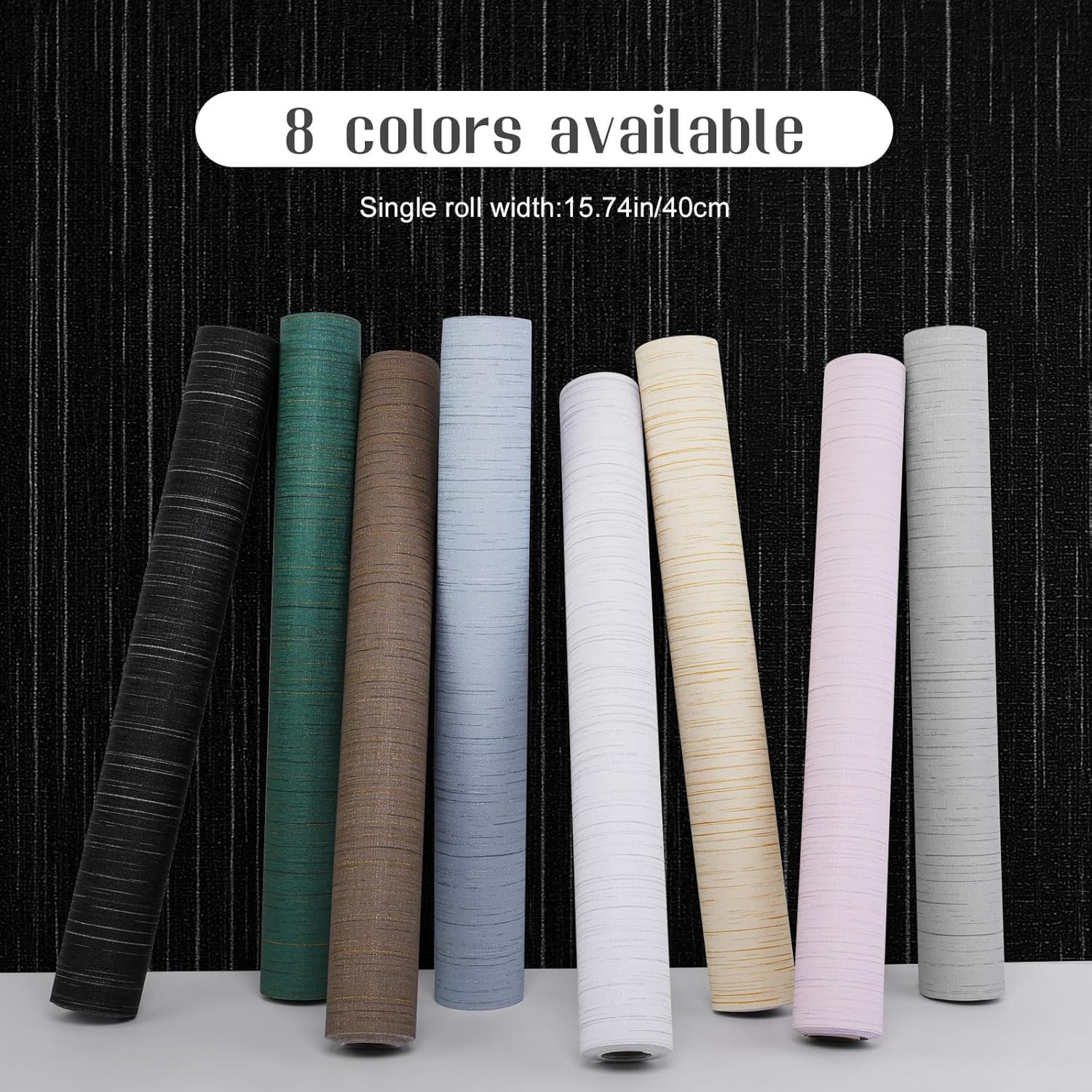
The grasscloth texture on this black wallpaper creates dimension that photographs can’t fully capture—you need to see how light plays across the woven pattern throughout the day. At 15.7 inches wide and 120 inches long, the roll covers a substantial area. The black color reads sophisticated rather than harsh, especially when the grasscloth texture catches light and reveals subtle variations in tone.
We used this to create a feature wall behind open shelving, and the dark background made white storage baskets and supplies pop visually. The texture hides the seams between strips better than smooth wallpapers, which mattered since we needed three strips to cover the wall. The adhesive required firm pressing, particularly along edges where the textured surface created slight gaps. Once properly adhered, it stayed secure even when we accidentally splashed it with diluted bleach during cleaning.
Pros:
- Grasscloth texture adds sophisticated dimension that elevates laundry room aesthetics
- Black color creates dramatic backdrop that makes white appliances and storage stand out
- Textured surface disguises seams between strips better than smooth wallpapers
- Generous roll dimensions provide substantial coverage for accent walls
- Dark color conceals stains and marks that would show on lighter wallpapers
Cons:
- Black color may make small or windowless laundry rooms feel more confined
- Textured surface requires extra pressing along edges to ensure full adhesion
- Dark grasscloth shows dust and lint more visibly than patterned alternatives
My Recommendation
We recommend the Qianglive Black Grasscloth for laundry rooms where you want textural interest and dramatic contrast. The black color works best in spaces with good lighting or white/light gray cabinets that prevent the room from feeling too dark. We found it particularly effective as a backdrop for open shelving systems, where the dark wall makes organized supplies and décor items stand out as intentional design elements rather than necessary clutter.
| Best for | Why |
|---|---|
| Feature walls | Black grasscloth creates dramatic focal point behind shelving or appliances |
| Modern design | Sophisticated texture suits contemporary and minimalist aesthetics |
| Visual contrast | Dark background makes white or light-colored elements pop dramatically |
Buying Guide: Choosing Peel and Stick Wallpaper for Laundry Rooms
Laundry rooms present unique challenges that influence wallpaper selection. Moisture from washers and dryers, temperature fluctuations, and occasional splashes from detergent or fabric softener mean your wallpaper needs to withstand more than typical interior walls.
Material matters in humid environments. We consistently found vinyl-backed wallpapers performed better than paper-backed options in laundry rooms. Vinyl resists moisture, wipes clean easily, and maintains adhesion even when humidity spikes during dryer cycles. Paper-backed wallpapers work fine in climate-controlled laundry rooms but may peel or bubble in damp basements or poorly ventilated spaces.
Texture serves double duty. Grassweave, linen, and other textured patterns don’t just add visual interest—they hide wall imperfections and disguise seams between strips. Laundry rooms often have patched walls from previous shelving or utility hookups. Textured wallpapers camouflage these better than smooth patterns or solid colors.
Consider your wall condition before buying. Peel-and-stick wallpaper adheres best to smooth, clean, painted walls. If your laundry room has textured drywall, glossy paint, or exposed concrete, you’ll need to prep surfaces first. Lightly sand glossy paint, fill major holes or cracks, and ensure walls are completely dry before application. We learned this after watching wallpaper peel from a slightly damp basement wall within days.
Pattern scale affects room perception. Large, bold patterns can overwhelm small laundry closets but create impact in spacious mudrooms. Small, repetitive patterns work universally but may feel busy in compact spaces. We found medium-scale patterns or textured solids offered the most versatility across different laundry room sizes.
Think about maintenance requirements. Laundry rooms accumulate lint, dust, and occasional splashes. Dark colors hide lint better than light ones, but they show dust. Smooth surfaces wipe clean more easily than deeply textured ones. Consider how much maintenance you’re willing to do—if you rarely clean walls, choose patterns and colors that naturally disguise dirt.
Final Verdict: Which Wallpaper for Your Laundry Room?
For moisture resistance and durability, the NuWallpaper Cream Vinyl Grassweave delivers the best performance in humid laundry environments. The vinyl construction withstands splashes and steam while the texture hides imperfections.
Budget-conscious renovators should consider the NuWallpaper Breezy, which provides clean coverage at an accessible price point. It works best in climate-controlled spaces rather than damp basements.
If you want design impact, the NuWallpaper Navy Secret Garden creates a bold focal point that transforms utilitarian spaces into rooms you actually want to spend time in. The dark background also conceals the inevitable lint and dust that accumulates in laundry areas.
For those embracing the laundry room’s function, the TOARTi Laundry Wallpaper celebrates the space’s purpose with themed graphics that work particularly well behind open shelving. The REDAMANCY Clothes Line Art takes a more sophisticated approach with its artistic rendering, perfect for modern homes where the laundry room doubles as a design statement.
Frequently Asked Questions
Can peel and stick wallpaper withstand moisture in laundry rooms?
Vinyl-backed peel and stick wallpaper handles laundry room moisture well, resisting humidity from dryers and occasional splashes from sinks or detergent. Paper-backed options work in climate-controlled spaces but may peel in damp basements or poorly ventilated rooms. We recommend vinyl construction for maximum durability, especially near washers and utility sinks where water exposure is more frequent.
How do I prepare laundry room walls for peel and stick wallpaper?
Clean walls thoroughly with mild soap and water, then let them dry completely for at least 24 hours. Lightly sand glossy or semi-gloss paint to improve adhesion. Fill holes and cracks with spackle, sand smooth, and touch up with paint if needed. Ensure walls are completely dry—moisture trapped under wallpaper causes bubbling and peeling. We learned this the hard way in a basement laundry room.
Will peel and stick wallpaper damage painted walls when removed?
Quality peel and stick wallpaper removes cleanly from most painted walls without damage, especially if you peel slowly at a 45-degree angle. Freshly painted walls (less than 30 days old) or walls with poor-quality paint may experience some damage. Test a small corner first if you’re concerned. We’ve removed wallpaper from dozens of walls with minimal issues when proper removal technique is used.
How much wallpaper do I need for a typical laundry room?
Measure wall height and width, multiply to get square footage, then add 10-15% for waste from pattern matching and trimming around obstacles. A standard 8×10 foot wall needs approximately 88-92 square feet of wallpaper accounting for waste. Most peel and stick wallpaper rolls cover 28-30 square feet, so you’d need three rolls for that wall. Always round up rather than running short mid-project.
Can I install peel and stick wallpaper over existing wallpaper?
We don’t recommend installing peel and stick wallpaper over existing wallpaper. The new wallpaper adheres to the old layer, not the wall itself, creating a weak bond that often fails. Old wallpaper may also bubble or peel under the new layer. Remove existing wallpaper completely, repair and prep the wall surface, then install your peel and stick option for best results and longevity.